

A video costs half as much to produce today as it did two years ago. That is good news for your budget. It is bad news for your brand, and nobody has put it to you that way.
Here is what is happening. AI video generation went from gadget to industry standard in one cycle. According to the IAB’s 2025 Digital Video Ad Spend & Strategy report, relayed by DesignRush, 86% of US media buyers already use generative AI to create video assets or plan to. The first benefit they cite is no longer creativity. It is lower costs. Mondelez told Reuters it is cutting its video production costs by up to 50% thanks to AI tools developed with Publicis and Accenture. When a food giant halves its bill, the whole market follows.
The result is mechanical. When producing a decent video costs next to nothing, everyone produces one. The web fills up with a flood of visually competent, technically clean films that all look alike. Chris Marcus, creative director at Colormatics, sums up the trap in one sentence every marketing leader should pin above their screen: confusing efficiency with effectiveness produces work that is visually competent but emotionally empty.
Read it twice. Efficient does not mean effective. A video generated in three hours for 200 euros can be flawless and stir nothing in anyone.
Commoditisation moves value, it does not destroy it
Two lazy reflexes have to be resisted here. The first is to cry wolf and reject AI outright. That is wrong and it will cost you money. AI-driven YouTube campaigns show a 17% higher return on ad spend than manual campaigns, according to a Google and Nielsen analysis cited by DesignRush. For targeting, cutting variants, subtitling and repetitive post-production, AI is an excellent performance tool. Refusing it on principle is shooting yourself in the foot.
The second reflex is the opposite, and just as hollow: rebranding yourself as an “AI-powered” agency and selling the technology as though it were the value. It is not. The technology is everywhere, so it no longer sets anyone apart. When a tool is available to 86% of the market, it stops being an advantage. It becomes the ground everyone walks on.
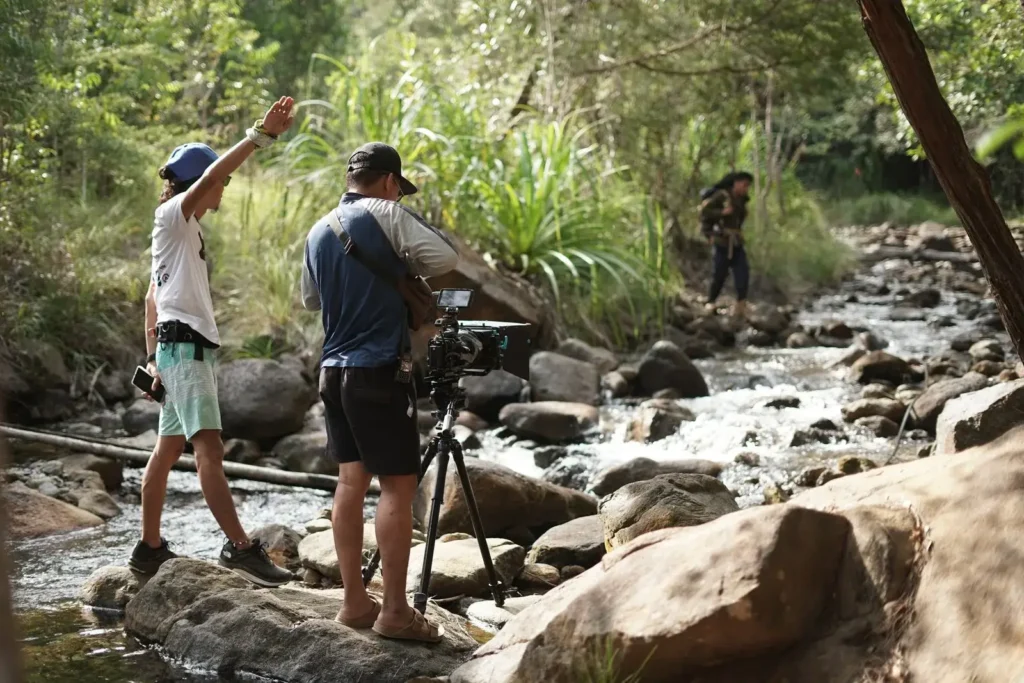
The real reading lies elsewhere. When a skill becomes a commodity, its value does not disappear. It moves towards whatever stays rare. And what stays rare, in 2026, is no longer video execution. It is what the machine does not make on its own: location scouting, directing real people, capturing an authentic moment, the emotional coherence of a film that holds up over eight minutes. Documentary craft, in short. Proof through the real.
AI executes fast. It does not decide why.
What the machine cannot shoot for you
Let us take a concrete case, because authenticity is not proclaimed, it is demonstrated.
An NGO is preparing a fundraising campaign. Its strongest argument is not a results chart. It is the face of a displaced family telling, in their own language, what the programme changed for them. No generative model produces that shot. Not because the technique is missing, but because the material is missing. You have to be physically there, at the right moment, with the earned trust of the person being filmed. You have to know the informed-consent protocols, and how to frame a vulnerable person without reducing them to an object of pity. A synthetic video imitating that scene would not merely be false. It would be a betrayal, and donors would sense it.
That is exactly the point for Fatimetou and her NGO communications team. A documentary for funders draws all its strength from the authenticity of the field. Generating it would mean sawing off the branch trust rests on. On a campaign co-funded by a donor, the mandatory acknowledgement, the logo rules and the image-consent protocols are not finishing details: they are the conditions of the funding. No tool knows your donor cycle for you.
The calculation is different for Aïcha, head of marketing at an international group, but it points to the same place. In an ocean of generated videos that all look alike, a brand documentary becomes an act of distinction. Not because it is prettier. Because it carries proof the others cannot manufacture: we were there, it was true, here is what we saw. At a time when any competitor can put out a clean video in an afternoon, the field becomes the luxury money alone does not buy.
In our studios: we never start a documentary with the storyboard. We start with the scouting. Who speaks, in which language, with what reserve, and why this person rather than another. It is that invisible phase, impossible to automate, which decides whether the film will provoke something or join the flood.
The data confirms the shift, not the rejection
The figures tell a transition, not a rupture. Wistia’s State of Video Report 2026, built on more than 900 professionals and the analysis of over 13 million videos, shows that more than a third of teams already use AI in their video workflow and that more than half are putting more budget into it this year. Adoption is real and it is accelerating. Nobody is going back.
But the same report points to where AI truly delivers, and it is not where you would expect. Still according to Wistia, teams using AI in their video production are 82% more likely to have subtitles in several languages. That is the right use: AI excels at the repeatable technical task, multilingual subtitling, format variants. Not at sensitive storytelling. For a team that delivers natively in French, Spanish and English, that is exactly the right division of labour. The machine speeds up the multilingual work, the human keeps hold of the emotion.
And video still pays. A compilation of 2026 B2B statistics aggregated by Levitate Media reports that 82% of video marketers declare a good return on investment (Wyzowl 2026) and that 83% say video directly increased their sales. The format is not in crisis. It is splitting in two. On one side the disposable video, abundant, interchangeable, now almost free. On the other the film that leaves a mark, rare by construction, which becomes the only real signal of differentiation when everything else looks the same.
Where to put AI, where to put the field
The question is therefore not “AI or no AI”. It is “AI for what, and the field for what”. The line is clear once you look at it closely.
AI takes on what is repeatable and measurable: subtitling and multilingual translation, format variants for each network, the rough cut, the optimisation of distribution campaigns. That is where it saves time and lifts return on ad spend, and it would be absurd to go without.
Human craft keeps what carries the proof: the scouting, the choice of the people filmed, the direction of real moments, the edit that builds an emotion rather than a sequence of shots, the coherence of a story that holds. That is what your competitors cannot copy in an afternoon, because it is not generated, it is earned in the field.
In our studios: the sharing rule is simple. If a task can be done by a tool without loss of truth, it goes to the tool. If it engages the trust of someone confiding on camera, it goes to a human who answers for what they film. Trust is not outsourced to a model.
For you, marketing director or communications lead, the consequence is concrete. The video budget reorganises itself. The share you were spending on producing ten decent films can fund three films that count, plus the AI to adapt and distribute them everywhere. You pay less for volume, and reinvest the margin in the one place where value has taken refuge: the real.
A deliverable is not a result. A clean video is not a film that convinces. As the machine makes execution free, what you still have to defend is precisely what it cannot shoot for you.